For years, SEO advice often sounded simple:
“Publish more content.”
Many websites followed that advice aggressively. They created hundreds — sometimes thousands — of blog posts hoping traffic would eventually grow through sheer volume alone.
In some cases, that strategy worked temporarily.
But modern SEO has changed significantly.
Today, many websites continue publishing content consistently while struggling with:
- stagnant rankings
- weak authority
- poor organic growth
- inconsistent traffic
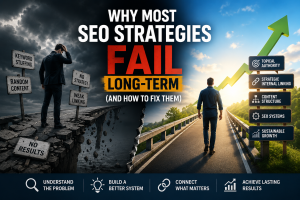
The issue is often not effort.
The issue is structure.
Modern Google increasingly rewards:
- topical authority
- semantic relevance
- internal linking
- organized content systems
- contextual relationships
In this guide, we’ll explain why publishing more content alone no longer works and what sustainable SEO growth actually requires today.
Table of Contents
Why Content Volume Used to Work
Older search algorithms relied heavily on:
- keyword matching
- backlinks
- indexed page quantity
As a result, websites could often increase traffic simply by publishing large amounts of keyword-targeted content.
This created the “more content = more traffic” mindset.
However, search engines have evolved dramatically.
Modern Google increasingly attempts to understand:
- relationships between topics
- expertise signals
- semantic structure
- content hierarchy
- topical depth
This means content quantity alone is no longer enough.
How Modern SEO Has Changed
Google now evaluates websites far more contextually than before.
Instead of analyzing pages completely independently, search engines increasingly examine:
- how pages connect
- whether topics reinforce each other
- how authority flows across a website
- whether expertise appears genuine and organized
This is why smaller websites with focused structure often outperform massive websites publishing disconnected content at scale.
👉 Related Reading:
The Problem With Random Content Publishing
Many websites continue publishing articles randomly without strategic organization.
For example:
A website may publish:
- one article about SEO
- one article about finance
- one article about gaming
- one article about cryptocurrency
without any semantic relationships between them.
This weakens:
- topical authority
- relevance signals
- expertise perception
- authority concentration
Random publishing often creates:
- isolated pages
- fragmented authority
- weak hierarchy
- poor internal linking
Modern SEO increasingly rewards connected ecosystems instead.
Why Topical Authority Matters
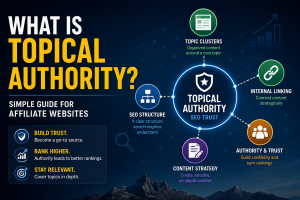
Topical authority has become one of the most important concepts in sustainable SEO.
Google increasingly wants evidence that a website:
- deeply understands a subject
- covers topics comprehensively
- demonstrates semantic consistency
One article about SEO is rarely enough anymore.
Strong authority usually comes from:
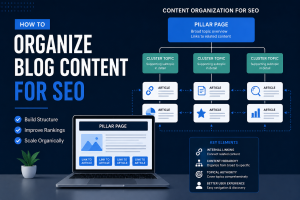
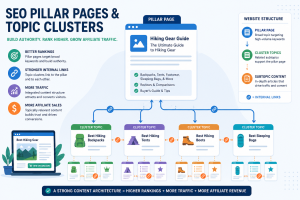
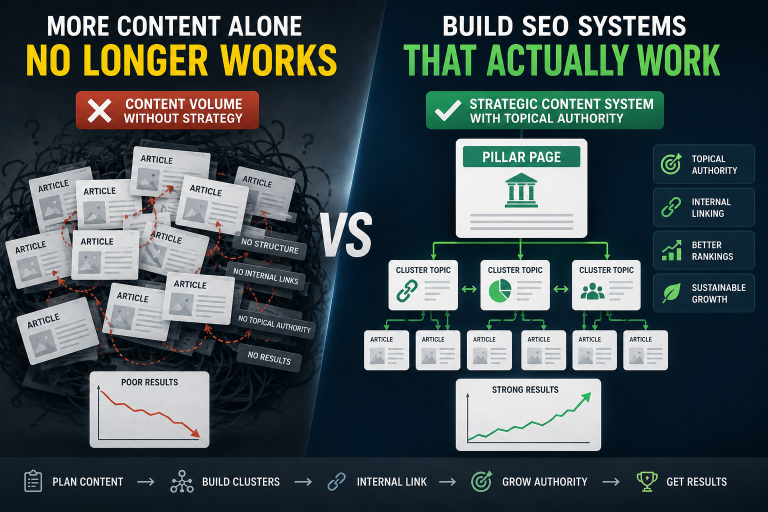
- clusters of related articles
- pillar pages
- internal linking
- connected topical systems
For example:
Instead of publishing one isolated article about:
“Internal Linking”
a stronger strategy would connect it with:
- topic clusters
- website structure
- pillar pages
- semantic SEO
- scalable architecture
This creates stronger contextual relevance across the website.
👉 Related Reading:
Internal Linking and Semantic Relationships
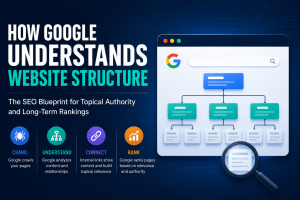
Internal linking plays a critical role in modern SEO.
Every internal link helps search engines understand:
- relationships between pages
- hierarchy
- topical relevance
- authority flow
Without strategic internal linking, even strong content can remain isolated.
A connected content ecosystem allows pages to reinforce each other semantically instead of competing independently.
This improves:
- crawlability
- indexing
- contextual understanding
- authority consolidation
👉 Related Reading:
Content Without Structure
One of the biggest SEO problems today is content without organization.
Many websites publish articles continuously without:
- hierarchy
- topic planning
- semantic grouping
- pillar structures
Over time, this creates:
- keyword cannibalization
- inconsistent authority
- weak navigation
- poor user experience
Search engines increasingly reward websites with:
✔ organized architecture
✔ connected topics
✔ semantic consistency
instead of random article accumulation.
👉 Related Reading:
The Scalability Problem
Weak content systems become harder to manage as websites grow.
Large content libraries often develop:
- orphan pages
- overlapping topics
- crawl inefficiencies
- diluted authority
- weak hierarchy
This is one reason many websites eventually hit:
- traffic plateaus
- ranking instability
- declining growth
Scalable SEO requires systems — not endless disconnected publishing.
What Sustainable SEO Looks Like
Sustainable SEO focuses on:
- structure
- semantic relevance
- topical authority
- content relationships
- hierarchy
- scalability
Instead of creating isolated blog posts endlessly, successful websites build:
connected SEO ecosystems.
These systems typically include:
- topic clusters
- pillar pages
- internal linking
- focused expertise
- strategic content mapping
This helps strengthen:
- authority
- rankings
- crawlability
- long-term growth stability
Building SEO Systems Instead of Content Libraries
One of the biggest mindset shifts in modern SEO is moving away from:
❌ content quantity obsession
toward:
✔ strategic SEO systems
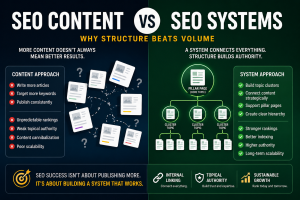
A content library alone does not create authority.
Relationships between pages create authority.
Strong SEO systems help:
- organize expertise
- reinforce semantic relevance
- improve authority flow
- support scalability
This is why websites with fewer but better-connected articles often outperform massive sites publishing random content continuously.
👉 Related Reading:
Common Content Strategy Mistakes
Many websites unintentionally weaken their SEO through poor content strategy.
Common mistakes include:
1. Publishing Without Structure
Articles remain disconnected and semantically weak.
2. Weak Internal Linking
Important topic relationships never get reinforced.
3. Chasing Random Keywords
Trying to rank for everything weakens expertise signals.
4. No Pillar Strategy
Without authority hubs, content lacks hierarchy.
5. Ignoring Semantic Relationships
Modern SEO increasingly rewards contextual relevance.
Publishing More Content Is No Longer Enough
Many websites continue producing articles consistently while struggling with weak rankings and stagnant traffic.
Without:
- topical authority
- internal linking
- semantic organization
- scalable structure
content volume alone rarely creates sustainable SEO growth.
👉 Brisk Web Services helps businesses build connected SEO systems designed for long-term authority, scalability, and organic growth.
Conclusion
Publishing more content alone no longer guarantees SEO success.
Modern search engines increasingly reward websites that demonstrate:
- organized expertise
- semantic relationships
- topical depth
- strategic internal linking
- scalable structure
Instead of treating SEO as endless article publishing, successful websites increasingly build:
connected authority ecosystems.
As Google continues evolving toward contextual understanding, structure and relationships will become even more important than raw content volume.