
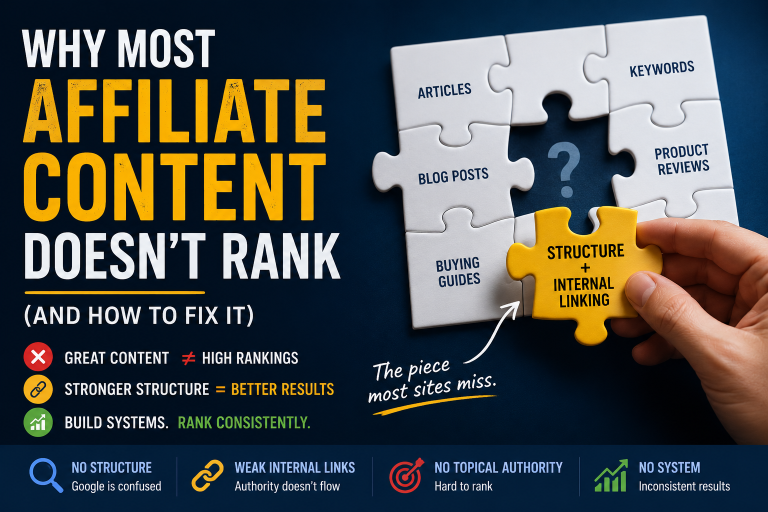
You’ve written the articles.
You’ve done keyword research.
You’ve followed SEO advice.
And still…
👉 your content doesn’t rank.
This is one of the most frustrating situations for affiliate website owners.
But here’s the truth most people don’t realize:
👉 The problem is usually not your content.
👉 It’s your structure.
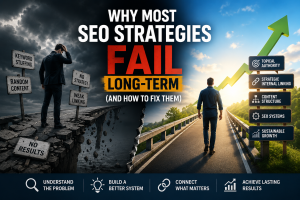
Most websites are not built as SEO systems — they’re just collections of disconnected articles.
And that’s why they fail.
Table of Contents
The Biggest SEO Myth: “Just Publish More Content”
You’ve probably heard this advice:
- publish more articles
- target more keywords
- keep creating content
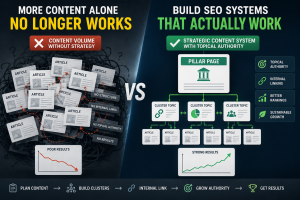
But if your existing content isn’t ranking, adding more of it won’t fix the problem.
It will only make it worse.
👉 More content without structure = more confusion for Google
What’s Actually Going Wrong?
Let’s break it down.
1. No Content Structure
Most affiliate websites publish content randomly:
- one article about laptops
- another about phones
- then something completely unrelated
There’s no system.
No hierarchy.
No connection between pages.
👉 This is why topic clusters matter for SEO
2. Weak Internal Linking
Even when content is good, it’s often not connected properly.
Pages exist in isolation.
There’s no clear flow of authority.
👉 This is exactly where a proper internal linking strategy for affiliate websites makes a massive difference.
3. No Topical Authority
Google doesn’t just rank pages.
It ranks websites that demonstrate authority in a topic.
If your content is scattered, you never build that authority.
👉 Learn more about topical authority and how it works
4. Content Without Purpose
Many articles are written just to “target keywords”.
But they don’t:
- guide the user
- support a bigger topic
- lead to conversions
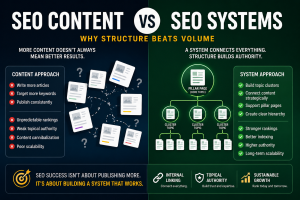
👉 This is the difference between content and a system.
🔵 QUICK REALITY CHECK
If your website has:
- 20+ articles
- decent content quality
- little to no traffic
👉 The issue is almost always structure.
Not Sure If This Applies to You?
If you’re unsure whether your content is structured correctly, it’s worth taking a closer look at your SEO setup.
What Actually Works Instead
Instead of random publishing, successful websites use:
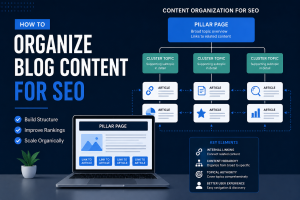
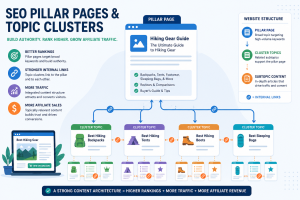
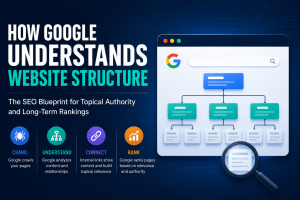
1. Topic Clusters
Content is grouped around core topics.
👉 pillar pages + supporting content
👉 everything connected
See full guide here
2. Internal Linking Systems
Pages are connected strategically.
👉 authority flows
👉 structure becomes clear
3. Topical Authority
Instead of covering everything, they go deep into specific areas.
👉 this builds trust with Google
👉 and improves rankings
4. SEO Systems (Not Just Content)
Everything works together:
- content
- structure
- linking
- strategy
👉 This is what creates consistent rankings.
Why This Matters for Affiliate Websites
Affiliate websites rely on:
- organic traffic
- trust
- conversions
Without structure:
❌ traffic stays low
❌ rankings fluctuate
❌ conversions suffer
With structure:
✔ traffic becomes stable
✔ rankings improve
✔ content starts working as a system
Conclusion
If your content isn’t ranking, don’t assume it’s not good enough.
In most cases:
👉 it’s just not structured properly.
Stop focusing only on publishing more.
Start focusing on:
✔ how your content is connected
✔ how your site is organized
✔ how your SEO system works
🚀 Your Content Isn’t the Problem — Your Structure Is
If your website isn’t getting results, there’s a high chance your SEO structure is holding it back.
I offer a focused SEO Structure Audit where I identify:
- structural issues
- internal linking gaps
- missed ranking opportunities
👉 Get Your SEO Structure Audit

2 Responses
I just like the helpful information you provide in your articles
Thank you Barbara !